Logo du fabricant du granulateur BSGHG

BSGH GRANULATOR / EQUIPMENT COMPARISON

Double-Shaft Shredder VS. Hammer Mill: Which One Do You Need?

Introduction

Twin-shaft shredders et hammer mills both reduce material size, but they serve different processing needs. A double-shaft shredder can handle a wide range of bulky materials, including scrap metal and tough non-metallic waste, breaking them into manageable pieces. A hammer mill, in metal recycling applications, is often used for further size reduction and to prepare materials for downstream separation.

For scrap metal recyclers, the right choice depends on the type and size of material being processed and the desired output. One machine may be enough. In other applications, a double-shaft shredder prepares the material for a hammer mill, with each machine handling a different stage of the recycling process.

Broyeur MS-D1200 avec 2 moteurs
Double-Shaft Shredder
broyeur à marteaux du fabricant bsgh
Hammer Mill
In This Article

Choosing A Machine?

Tell us about your material and processing target.

Double-Shaft Shredder VS. Hammer Mill: Key Differences

Operating Principle: Low-Speed Shearing vs. High-Speed Impact

UN broyeur à double arbre uses toothed blades on two counter-rotating shafts to grip, shear, and tear metal scrap at low speed and high torque. A hammer mill, by contrast, uses hammers mounted on a high-speed rotor to break scrap metal material through repeated impacts. The main difference is how they apply force: shredder cuts and tears material between its cutters, while hammer mill breaks it down through impact inside the crushing chamber.

Suitable Materials: Versatile Shredding vs. Metal-Focused Crushing

A double-shaft shredder can process a wide variety of metal and non-metal materials, including scrap metal, plastics, rubber, and wood, depending on the machine configuration. This makes it a versatile option for recycling facilities handling different types of waste.

In comparison, the hammer mills discussed here are mainly used for metal recycling, processing suitable materials such as scrap metal sheets, aluminum profiles, and metal casings, engine block and so on. The choice depends not only on the material type but also on its thickness, structure, and suitability for the selected machine.

Feed Material And Feeding Requirements

UN broyeur à double arbre is generally suited to bulky, irregular scrap and can be loaded in batches or fed by conveyor, depending on the model. A hammer mill typically requires a steady, controlled feed that matches its inlet size and crushing capacity. Neither machine has unlimited feeding capability: material dimensions, thickness, and loading rate must remain within the selected model’s limits.

When scrap is too large for a hammer mill, a broyeur à double arbre can be used to reduce it to a suitable feed size. Suitable material can be fed directly into the hammer mill without pre-shredding.

Output Size And Shape

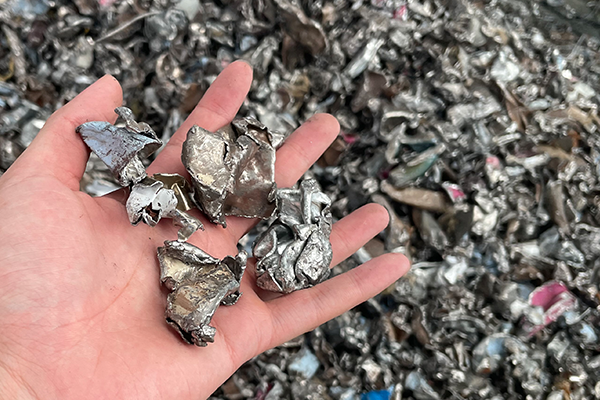
UN broyeur à double arbre typically produces 5-20cm or longer coarse strips or irregular chunks, while a hammer mill generally produces smaller fragments. A double-shaft shredder typically produces coarse strips or irregular chunks, often 5–20 cm or longer, while a hammer mill generally produces smaller fragments. If you only need to reduce bulky scrap into manageable pieces, a double-shaft shredder may be enough. If the material needs further size reduction for downstream processing or separation, then you can add a hammer mill after first shreddding.

In a screenless broyeur à double arbre, cutter width and tooth configuration influence final products size but can’t guarantee uniform dimensions, particularly the length of the pieces. In a hammer mill fitted with a screen, the openings help control discharge size, together with hammer configuration, rotor speed, and material properties. 

déchets de traitement de la ferraille
Métaux non ferreux provenant de voitures hors d'usage

Role In A Recycling Line

UN broyeur à double arbre is often used for initial size reduction, such as cutting bulky scrap cables into manageable pieces before they enter a granulateur de cuivre. A hammer mill provides finer processing for scrap metals but can’t process scrap cables, breaking suitable metal scrap into smaller pieces to prepare it for material separation.

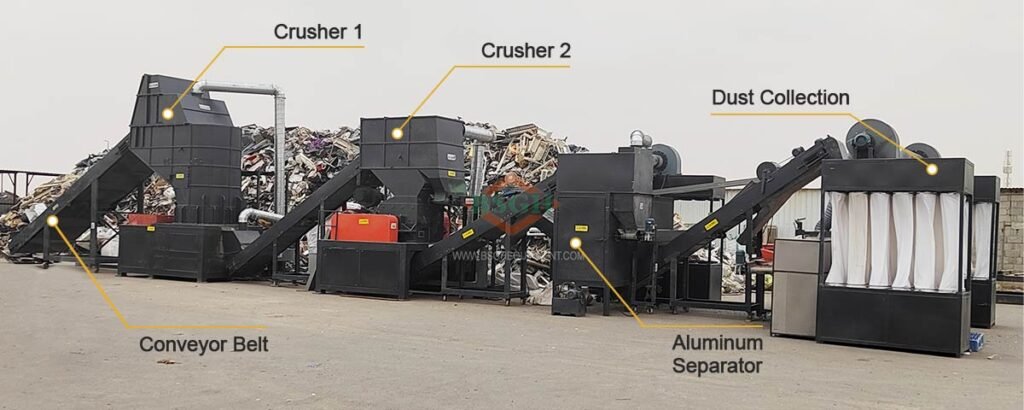
Depending on the material and feed size, a hammer mill can serve as the first size-reduction stage or work after a double-shaft shredder. When used together, the double-shaft shredder handles the bulky materials, while the hammer mill breaks it down further for downstream separation.

Machine de granulation de fil de cuivre BS-N130
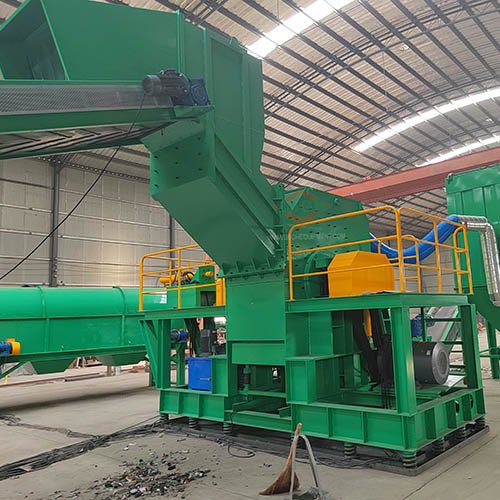
bsgh 180kw hammer mill crushing part for North Macedonia client

Operating And Maintenance Considerations

The key wear parts to inspect are the blades on a double-shaft shredder and the hammers and screens on a hammer mill. On the shredder, worn or damaged cutting edges can reduce the machine’s ability to grip and cut material. On the hammer mill, worn hammers can reduce crushing efficiency, while worn or damaged screens can affect the final particle size.

Comparison At A Glance

Comparison

Double-Shaft Shredder

Hammer Mill

Operating principle

Double-Shaft Shredder

Low-speed, high-torque shearing and tearing.

Hammer Mill

High-speed impact inside the crushing chamber.

Suitable materials

Double-Shaft Shredder

Handles a wide range of metal and non-metal waste, depending on machine configuration.

Hammer Mill

Primarily processes suitable metal scrap in the recycling applications discussed here.

Feed material and feeding requirements

Double-Shaft Shredder

Accepts suitable bulky or irregular scrap within the model’s size and load limits.

Hammer Mill

Needs controlled feeding; oversized or unsuitable feed may require preprocessing.

Output size and shape

Double-Shaft Shredder

Coarse strips or irregular chunks; dimensions vary with the cutters and material.

Hammer Mill

Generally smaller fragments; screens, where fitted, help control discharge size.

Role in a recycling line

Double-Shaft Shredder

Initial size reduction, or standalone processing when coarse output is sufficient.

Hammer Mill

Direct processing of suitable feed or further crushing before separation.

Operation and maintenance

Double-Shaft Shredder

Blades and associated cutting components.

Hammer Mill

Hammers and screens.

Which Machine Is Right for Your Material and Processing Goals?

Choose a Double-Shaft Shredder to Reduce Large, Bulky Scrap

Choose a double-shaft shredder when oversized scrap is your main processing problem and shredded particles will meet your requirements, then you do not need a second size-reduction machine. 

Select the cutter design, cutting chamber, and drive system around your material’s thickness, structure, and required hourly throughput—not its overall dimensions alone.

Choose a Hammer Mill When Your Priority Is Smaller and Even Crushed Materials

Choose a hammer mill when your material is suitable for impact crushing and the next processing stage requires smaller fragments or attached materials to be broken apart. Suitable feed can enter the hammer mill directly; pre-shredding is not always required. 

Start with the requirements of your separation equipment, then select the crushing configuration to match. The goal is not to make the scrap as fine as possible, but to produce material that matches your target. The target output size and required throughput should be considered together when selecting the screen, hammer arrangement and machine size.

Use Both When Bulky Scrap Needs Further Breakdown Before Separation

Use both machines when the incoming scrap is too bulky for the selected hammer mill and coarse shredding alone does not prepare it adequately for separation. The double-shaft shredder handles the initial reduction, and the hammer mill processes the resulting pieces further.

For example, BS-ACP1000 radiator recycling line combines a double-shaft shredder with a secondary hammer mill to process suitable scrap radiators. Pre-shredder first reduces radiators into manageable pieces. Hammer mill then breaks them down further to make separate copper and aluminum easily. In this recycling line, two machines perform different jobs within the same recycling process.

Conclusion: Choose the Right Machine for Your Material and Required Output

Start with your scrap material and the output size you need. Then identify the necessary processing steps and check whether the equipment can achieve that size. This helps you choose recycling equipment based on your actual processing needs—not just machine names or motor power.

 To help Granulateur BSGH assess your application, send us:

  • Material photos or videos showing the scrap you plan to process.
  • Maximum dimensions and thickness, including the largest or most difficult items.
  • Target hourly throughput in kg/h or tonnes/h.
  • Required output size and condition, including what will happen to the material next.
  • Details of existing downstream equipment, such as conveyors, granulators, or separation systems.

These details give us a starting point for discussing a standalone machine or a complete processing and recycling plant. When needed, material testing can help assess throughput, output size, and suitability for the next stage before you decide on a configuration.

fr_FRFrench

Metal briquetting machine

Maximize your recycling efficiency with our compact and powerful metal chip briquetting machines. Whether you’re dealing with small batches or large volumes of metal scrap, we have the perfect solution to fit your space and production needs.

Contact us today for a free, customized quote and discover how our briquette press can help you boost productivity and profits.

Solar Panel Recycling Machine

Ready to Turn End-of-Life Solar Panels into High-Value Treasure?

Whether you need a standalone Frame Dismantling Machine, a precision Glass Removal Machine, or a complete Solar Panel Recycling System—we have the right solution for your business.

Contact Us Today & Get a Free Quote tailored to your PV panels!

Soumettez votre demande

Which kinds of material you want to process?

Please fill in the following form(give us your specific requests, the detailed the better, so we can give you an optimal solution at the earliest time):

machine enquiry

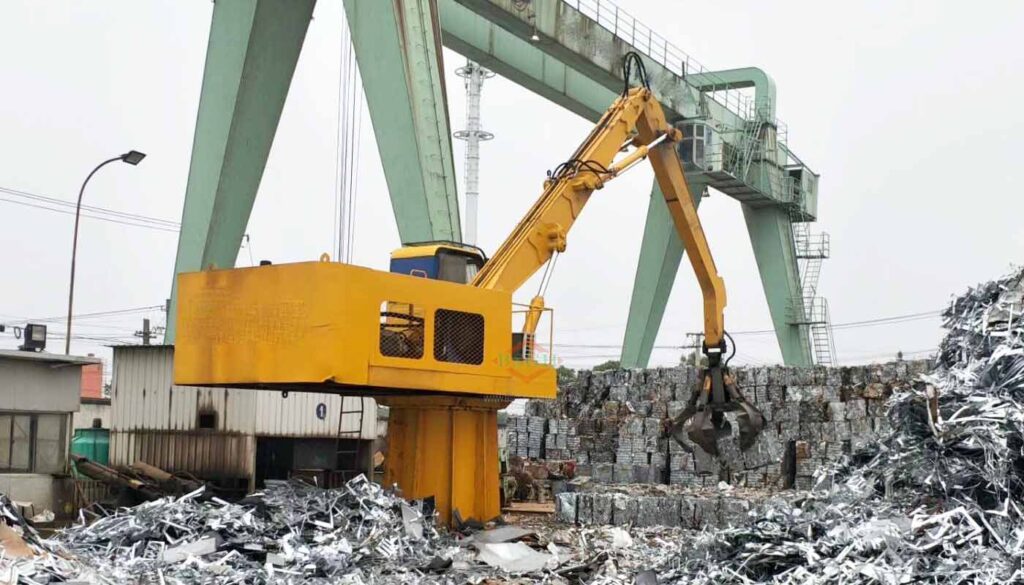
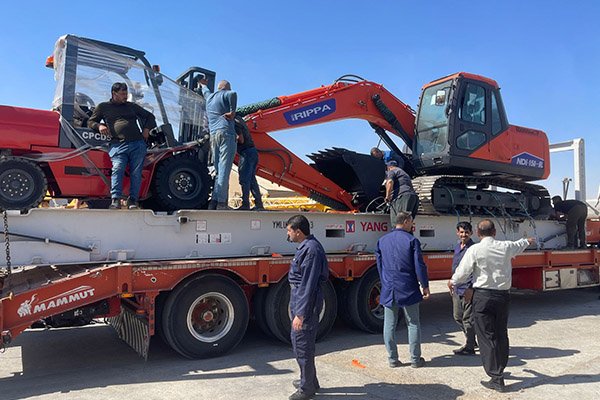
Excavateurs et chariots élévateurs de BSGH
grappin d'excavatrice rotatif de bsghgranulator
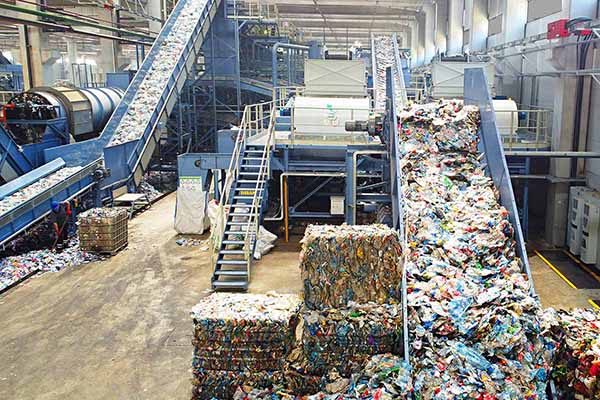
industrie du recyclage

From robust tools to advanced recycling machinery, we provide a comprehensive selection: cutting, moving, shearing, grap, baler, separation, a series of heavy-duty equipment engineered to meet the demands of diverse industrial operations and material types. Which kinds of function do you need? Send us your requests now to let our machine help you to get more profits.

quels types de machines à dénuder les fils voulez-vous ?

Veuillez remplir le formulaire suivant (indiquez-nous vos demandes ou vous pouvez choisir parmi) :

Machine à dénuder les fils à usage domestique
1,5 MM-38 MM; 2-45 MM; 2-76 MM; 2-60 MM;
Machine à dénuder les câbles industriels
10-120 MM; 10-160 MM; 60-200 MM

Selon vos demandes, je vous recommanderai la machine adaptée.

Machine de recyclage de radiateurs

structure de la machine de recyclage de radiateur

Nous disposons de toutes sortes de machines de recyclage de radiateurs, en plus des machines de décapage de radiateurs simples et des lignes de recyclage de radiateurs, des machines de découpe de radiateurs.

Nos machines sont capables de traiter tous types de radiateurs de récupération, y compris les radiateurs de voiture, les radiateurs de réservoir d'eau et les radiateurs de climatisation, les radiateurs revêtus d'aluminium, etc.

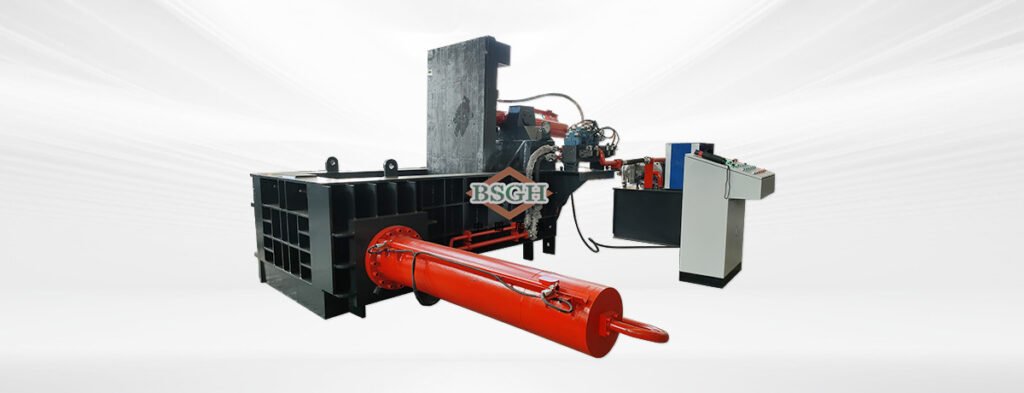
Presse à balles hydraulique pour métaux

fabricant de presses à balles pour voitures

Notre presse à balles pour métaux peut traiter tous les types de ferraille, en plus des métaux légers et lourds, des métaux ferreux et des métaux non ferreux ;

nos machines ont une petite pression jusqu'à une grande pression 80T, 125T, 135T, 160T, 200T, 250T, 315T et 400T, si vous ne savez pas quelle pression choisir, envoyez-nous votre photo de matériau ci-dessous et demandez un devis gratuit maintenant !

Dites-moi vos demandes

Nous avons:

  • Broyeurs monomoteur
  • Broyeurs à double moteur
  • Puissance de 3KW à 500KW et plus
  • Tous les broyeurs sont personnalisés en fonction de la matière première du client.
  • Notre machine peut déchiqueter : toutes sortes de métaux, plastiques, palettes en bois, etc.
  • Matériau des lames de broyeur : H13, SKD-11 et support personnalisé.
  • Quantité de dents du broyeur : selon les différents types de machines, les dents sont également différentes.
  • Prix du broyeur : de 4 900 à 300 000 USD
  • Type de broyeur : broyeur commun et broyeur à moteur hydraulique.

Pouvez-vous me dire quels types de matériaux vous souhaitez traiter ? Cliquez ci-dessous et envoyez une photo du matériel.

Logo du fabricant du granulateur BSGHG

Moteur électrique normal

Coque de moteur de processus | Stator de moteur | Arbre de moteur

Machine de recyclage de moteurs à énergie nouvelle

Découpe de coques de moteurs | Recyclage de stators de moteurs

Machine de recyclage de démarreur de voiture

Découpe de démarreur automatique | Pressage de démarreur automatique | Chauffage de démarreur de voiture | Machine de tirage de démarreur de voiture

Recyclage d'alternateur de voiture

Machine de découpe d'alternateur de voiture | Machine de tirage d'alternateur de voiture

Usine de recyclage de moteurs

Ligne de recyclage de stator de moteur | Ligne de recyclage de rotor de moteur | Usine de recyclage de moteurs entiers

Machine de recyclage de transformateurs

Pour le recyclage des petits transformateurs

Machine de recyclage de compresseur

Machine de découpe de coque de compresseur | Recyclage de stator de compresseur

Recyclage des moteurs de ventilateurs de plafond

Principalement pour le recyclage des moteurs de ventilateurs de plafond

Recyclage des interrupteurs magnétiques automobiles

Pour tous les types d'interrupteurs magnétiques de voiture

Recyclage du moteur du moyeu arrière du vélo électrique

Pour tous les types de moteurs de moyeu de vélo électrique

Presse hydraulique

Principalement pour la presse de toutes sortes de pièces de moteur | Assistance personnalisée
DITES-MOIQuels types de moteurs traitez-vous ?

Get 8 Free Miracle documents For Copper Recycling

popup
  • Free excellent pre-sale service gives you best purchase solution
  • Professional technology support when you use our machine
  • Ultimation operation guidance!

Just Leave Your Email, We will Send You Freely!

1: Get copper price today FREELY!

2: Enter into scrap metal group FREELY!

3: Leave your information, get a cable cutter for FREE!

4: ROI Analysis for FREE!

5: Get extra one year warranty for FREE!

6: Get usd100 coupon for FREE!

7: Get spare parts for FREE!

8: Best seller of the month FREELY!

Note: Your email information will be kept strictly confidential.

Note: Your email information will be kept strictly confidential.

Soumettez votre demande

Veuillez remplir le formulaire suivant (indiquez-nous vos demandes ou vous pouvez choisir parmi) :

Série D Différentes Capacités
50 kg/h, 70 kg/h, 100 kg/h, 200 kg/h, 300 kg/h
Série N Différentes Capacités
300 à 500 kg/h, 400 à 600 kg/h, 1 T/h, 1 200 à 1 500 kg/h

Selon les différentes capacités ci-dessus, dites-nous vos demandes, une fois que nous aurons obtenu vos informations détaillées pour vos demandes, nous vous contacterons dans un premier temps avec des solutions professionnelles et un support de l'achat à l'utilisation.